
The management system of the Private Higher Education Institution ‘Ukrainian Medical University’ ensures the organisation of the Institute’s educational, research, administrative and strategic activities in accordance with its Charter and the applicable legislation of Ukraine.
Structure
Structure
Organisational Structure
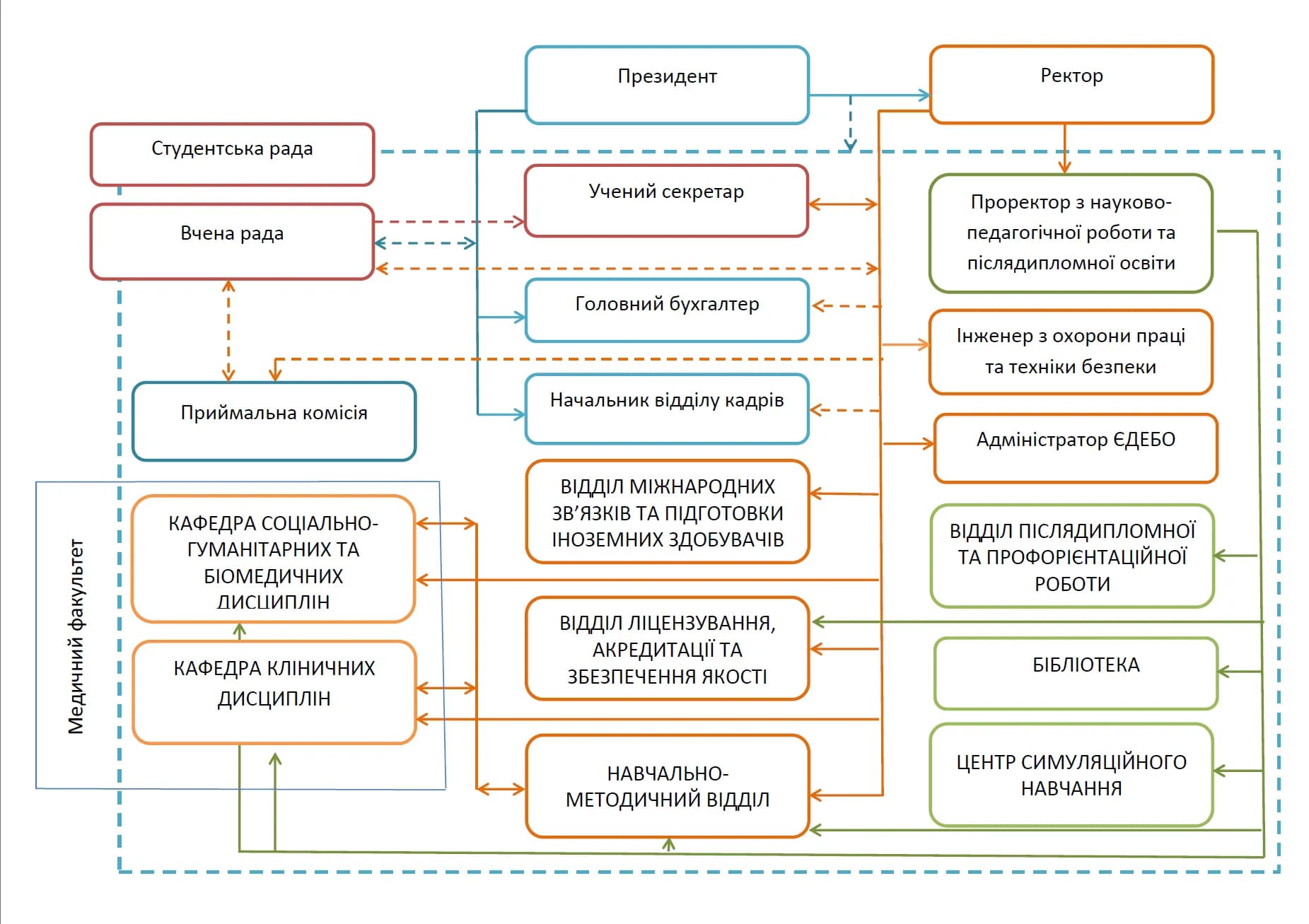
University Structure
The Private Higher Education Institution ‘Ukrainian Medical University’ is headed by the President, who approves the Institute’s organisational structure. The functions and status of its structural units are defined by the relevant regulations adopted by the Academic Council of the Institute.
Research and Academic Units
Research, research and production, design and other units that support the development of the Institute’s research and educational activities.
Centres and Departments
Educational, research and production centres, administrative and functional departments, as well as postgraduate and doctoral study units.
Clinical Training Sites
Clinics, hospitals and other healthcare facilities used for the practical and clinical training of students.
Educational and Methodological Units
Preparatory, educational and methodological units, and other structural units responsible for organising the educational process, retraining and professional development.
Laboratories and Infrastructure
Teaching and methodological rooms, laboratories, computer and information centres, and other educational infrastructure facilities.
Additional Units
Publishing, sports, student and other units whose activities contribute to the development of the Institute and comply with the legislation of Ukraine.
Regional Branches
To make educational services more accessible to students in their places of residence and to meet the regional labour market’s demand for qualified professionals, the Institute may establish branches as separate structural units in accordance with the applicable legislation of Ukraine.
Founders and Share Capital
Information about the founders of the Private Higher Education Institution ‘Ukrainian Medical University’, the amount of its share capital and the share held by each founder is available in:
- The Unified State Register of Legal Entities, Individual Entrepreneurs and Public Organisations.
- The Institute’s internal documents, in accordance with the applicable legislation.
This information is provided in accordance with established procedures and the requirements for transparency and openness in the Institute’s activities.
The Institute’s Governing Bodies
The Institute is governed through a system of collegial and individual governing bodies in accordance with its Charter. The management system is designed to ensure the Institute’s effective operation, strategic development and proper organisation of its educational and research activities.
General Meeting of the Founders
The Institute’s supreme governing body.
Supervisory Board
A collegial body responsible for overseeing the Institute’s activities and protecting the interests of its founders.
President
The sole executive and supervisory body responsible for strategic management and making key management decisions.
Academic Council
A collegial governing body responsible for addressing matters relating to educational, research, methodological, educational and human resources policies.
Working Bodies
The Presidium, Admissions Committee and other functional bodies established to coordinate specific areas of the Institute’s activities.
Working and Advisory Bodies
Working and advisory bodies are established within the Institute to address administrative, organisational and strategic matters efficiently.
Rectorate
The Rectorate is one of the Institute’s key working bodies and is responsible for addressing day-to-day operational matters. Its membership is approved by the President.
- President
- Rector
- Vice-Rector for Research, Teaching and Clinical Activities
- Academic Secretary of the Institute
- Accountant
- Heads of structural units
- Executive Secretary of the Admissions Committee
- Other officials, as determined by the President
Admissions Committee
The Admissions Committee is responsible for organising the admission of applicants to the Institute.
- The Committee’s membership is approved by the President, who serves as its Chair.
- The term of office of the Admissions Committee is one calendar year.
Other Working Bodies
Other working bodies may be established by decision of the President or the Academic Council, as required by the Institute.
Advisory Bodies
Advisory bodies are established to prepare recommendations and proposals concerning various areas of the Institute’s activities.
- Institute employees may participate in advisory bodies as part of their official duties or on a voluntary basis.
- The membership of advisory bodies and their respective regulations are approved by the governing body that decided to establish them.
Working and advisory bodies operate in accordance with the legislation of Ukraine, the Institute’s Charter and its internal regulatory documents.
Public Self-Governance
Public self-governance enables participants in the educational process to take part in decisions concerning the organisation of education, the protection of their rights and interests, and the development of the Institute.
Supreme Body of Public Self-Governance
The General Meeting (Conference) of the Staff is the principal collegial body of public self-governance. It comprises elected representatives of the Institute’s staff and students.
The Conference is convened at the initiative of the President, the Academic Council or at least one-third of the Institute’s employees.
At least 75% – research, teaching and academic staff employed by the Institute on a permanent basis.
At least 15% – elected student representatives, chosen by secret ballot.
Main Functions of the Conference
- Electing the Labour Disputes Commission in accordance with the law.
- Approving the Internal Regulations and the Collective Agreement.
- Decisions adopted by the Conference are implemented through orders issued by the President in accordance with the Institute’s internal procedures.
Student Self-Governance
Student self-governance is an integral part of the Institute’s public self-governance system and ensures student participation in addressing matters relating to education, student life, leisure activities, the protection of students’ rights and the development of the student community.
Student self-governance brings together all students of the Institute and may operate in various organisational forms.
Forms of Self-Governance
Parliament, senate, student group representatives, student rectorate, student deans’ offices, student councils and other forms.
Levels of Activity
Academic group, faculty, student halls of residence and the Institute as a whole.
Main Functions of Student Self-Governance Bodies
- Participating in the management of the Institute and discussing matters relating to the organisation of the educational process.
- Organising research, sports, cultural and other student events.
- Contributing to the assurance of the quality of education and the protection of students’ rights.
- Delegating student representatives to advisory bodies.
- Participating in addressing students’ social and everyday needs.
- Making proposals for the development of the Institute’s facilities and student infrastructure.
Supreme Body of Student Self-Governance
The supreme body is the General Meeting (Conference) of Students.
- Approving the regulations governing student self-governance, as well as the procedures for electing and operating its bodies.
- Receiving and reviewing reports from the representative and executive bodies of student self-governance.
- Determining the procedures for the use of funds and material resources allocated to student self-governance.
- Electing an Audit and Supervisory Commission to oversee the student self-governance budget.
Elections and Terms of Office
- Representative, executive and audit and supervisory bodies are elected for a term of one year.
- Student self-governance representatives may be removed from office following a general secret ballot, which may be initiated by at least 10% of the Institute’s students.
- Participation in student self-governance ends upon completion of studies at the Institute.
The Institute’s administration has no right to interfere in the activities of student self-governance bodies. Decisions adopted by student conferences are implemented in accordance with the procedures established by the Institute’s Charter and internal documents.
Scientific Societies of Students and Early-Career Researchers
Scientific societies are an integral part of the public self-governance system and contribute to the development of science, innovation, research culture and academic careers.
Students, postgraduate students, doctoral students and early-career researchers are involved in the activities of scientific societies in accordance with the requirements of the law, the Institute’s Charter and internal regulations.
Main Areas of Activity
- Organising research and educational events and promoting science among students.
- Engaging students in research activities.
- Representing the interests of students and early-career researchers before the Institute’s administration and external organisations.
- Promoting improvements in the quality of research and academic information exchange.
- Developing international research cooperation.
- Cooperating with the National Academy of Sciences of Ukraine, the National Academy of Medical Sciences of Ukraine and other research institutions.
The Institute provides appropriate organisational and material support for the activities of student self-governance bodies and scientific societies.
University Charter
The fundamental principles governing the organisation, structure, management and activities of the Institute are set out in its Charter.
University Funding
Information on the sources of funding and the main areas of expenditure of financial resources of the Private Higher Education Institution ‘Ukrainian Medical University’.
The Private Higher Education Institution ‘Dnipro Institute of Medicine and Public Health’ is a private higher education institution.
Sources of Funding
- Funds provided by the Institute’s founders;
- Other sources not prohibited by the legislation of Ukraine.
Sources of Income
- Fees for educational services paid by individuals and legal entities;
- Income from other activities carried out in accordance with the legislation of Ukraine.
The Institute does not receive public funds and is not subject to the Law of Ukraine ‘On the Openness of the Use of Public Funds’.
Use of Funds
- Delivery of educational activities in accordance with the legislation of Ukraine.
- Development of facilities and equipment, including laboratory equipment and teaching rooms.
- Expansion of the library collection and provision of licensed software.
- Funding the practical training of higher education students.
University Vacancies
Thank you for your interest in working at the Private Higher Education Institution ‘Ukrainian Medical University’. Please familiarise yourself with the procedure for the competitive selection of candidates for vacant positions.
Regulations Governing the University’s Structural Units
Official documents defining the responsibilities, functions, rights and operational arrangements of the Institute’s structural units.
Regulations on the Licensing, Accreditation and Quality Assurance in Education Department
11/1/26Regulations on the Academic and Methodological Department
11/4/26Regulations on the Human Resources Department
11/4/26Regulations on the International Relations and International Student Support Department
11/4/26Library Regulations
11/4/26